.png)
 Contact
 Focus and Scope
 Editorial Team
 Reviewer
 Peer Review Process
 Publication Ethics
 Author Fees
 Screening For Plagiarism
 Indexing Sites
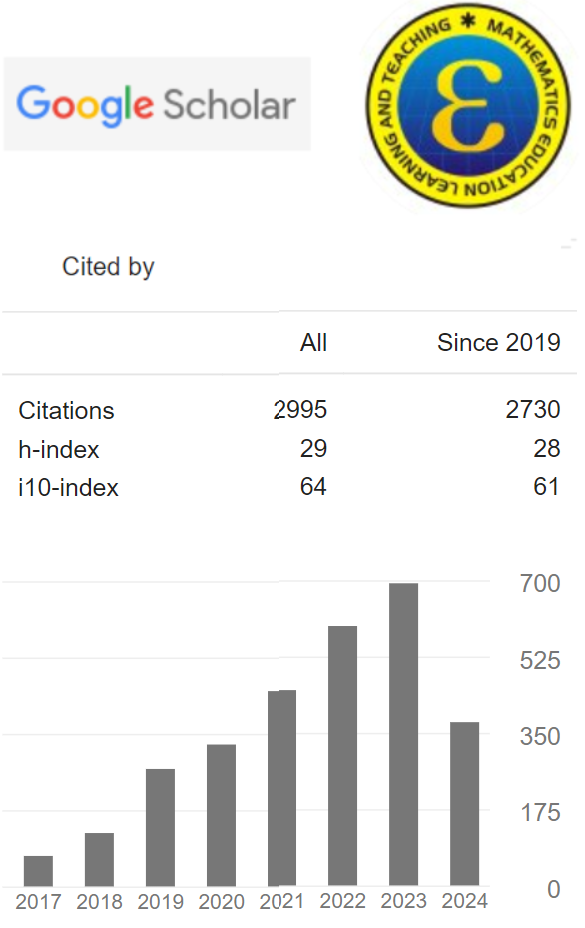
  Citedness in Scopus
 Statistics of Visitors
 Copyright Notice
 Journal History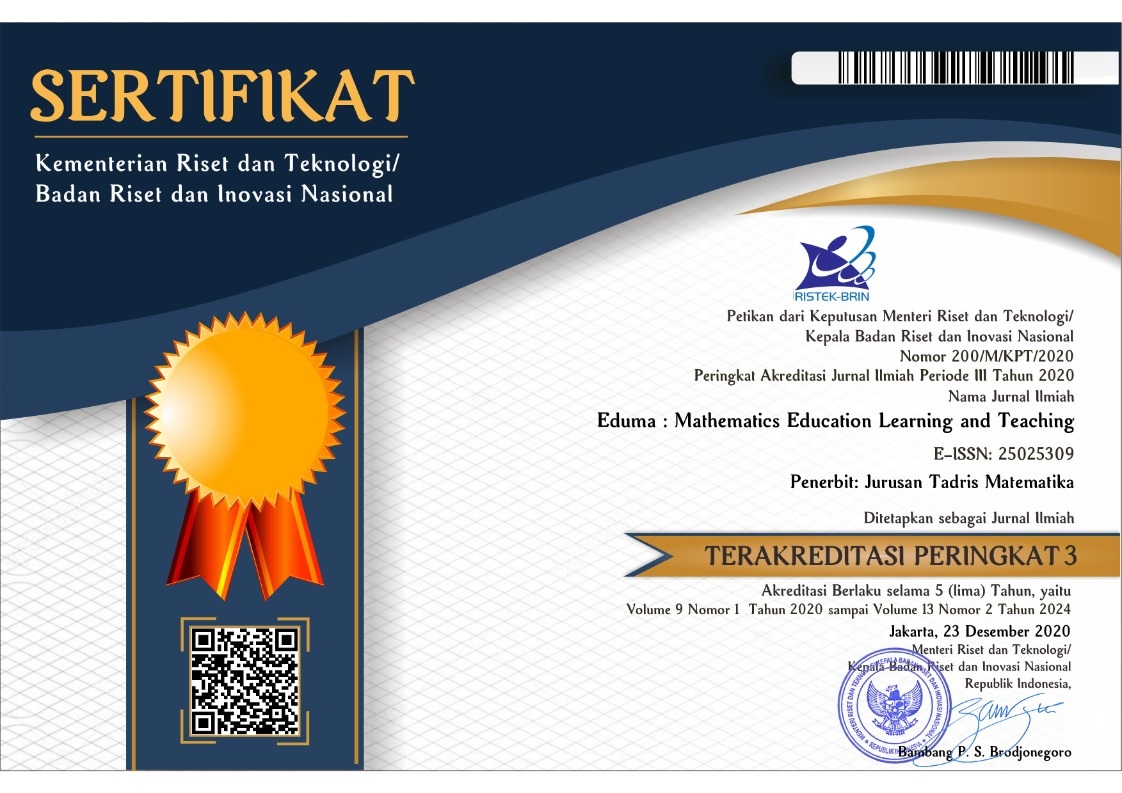








Efforts to Improve The Ability of Self Efficacy Students with The AIR Learning Model
(1) Muhammadiyah University Of Cirebon
(2) Muhammadiyah University Of Cirebon
(3) Muhammadiyah University Of Cirebon
(*) Corresponding Author
Abstract
The process of observation and interview with one of the teachers of SMP Islamiyah Weru is the background of this research by producing information that found difficulties and self-efficacy of students in solving some of the problems given by the teacher. This study aims to improve the ability of self-efficacy in students. Quantitative method, the type of research uses a quasi-experiment and the design used is nonequivalent control group. Application of the Auditory learning model, Intellectually, Repetition (AIR) contributes to improving the ability of self-efficacy with the results obtained namely the difference in the increase in self-efficacy in students whose learning uses the AIR learning model with Expository learning models with the average N-Gain self-efficacy of classroom students Experiment is higher than the control class so it can be concluded that the increase in students' self-efficacy in the experimental class is better than in the control class
Keywords
Full Text:
PDFReferences
Al, E. et. (2018). Penerapan Model Pembelajaran Auditory Intellectually Repetition (AIR) terhadap Hasil Belajar Kognitif Siswa Implementation of Auditory Intellectually Repetition (AIR) Learning Model to Students’ Cognitive Learning Outcomes. VII(1), 13–24. Retrieved from http://ojs.unm.ac.id/index.php/sainsmat
Alan, U. F., & Afriansyah, E. A. (2017). Kemampuan Pemahaman Matematis Siswa Melalui Model Pembelajaran Auditory Intellectualy Repetition Dan Problem Based Learning. Jurnal Pendidikan Matematika, 11(1). https://doi.org/10.22342/jpm.11.1.3890.67-78
Anike, Anike & Handoko, H. (2018). Pembelajaran Matematika Model Jigsaw Melalui Pendekatan Discovery Learning. EduMa, 7(1).
Astuti, R. (2018). Pengaruh Model Pembelajaran Auditory Intellectually Repetition (AIR) terhadap Kemampuan Berpikir Kritis Siswa pada Materi Kemagnetan Kelas. Indonesian Journal Of, 01(2), 1–12.
Fauziah, S.f, . at all. (2019). Pembelajaran Matematika Menggunakan Media Kartu Matematika Untuk Mengingkatkan Kemampuan Pemahaman Konsep Matematis Danself Efficacysiswa. Statistical Field Theor, 53(9), 1689–1699. https://doi.org/10.1017/CBO9781107415324.004
Huda, M. (2013). Pengajaran dan pembelajaran. Yogyakarta: Pustaka Pelajar.
Inayah.S., R. (2018). Penerapan Model Pembelajaran Creative Problem Solving Untuk Meningkatkan Kemampuan Metakognitif Siswa SMP dan Disposisi Matematis. Universitas Muahammadiyah Cirebon.
Kim, U. & P. Y. (2006). Factor Influencing Academic Achievement In Relational Cultures: The Role Of Self Relational, and Collective Efficacy. Jurnal Psikologi, 21(6).
Lestari, K.E. & Yudhanegara, M. R. (2017). Penelitian Pendidikan Matematika (Panduan Praktis Menyusun Skripsi, Tesis, dan Laporan Penelitian dengan pendekatan Kuantitatif, Kualitiatif, dan Kombinasi Disertasi dengan Model Pembelajaran dan Kemampuan Matematis. Bandung: Refika Aditama.
Manurung, S. (2016). Upaya Meningkatkan Kreativitas dan Hasil Belajar Matematika Siswa dengan Menggunakan Model AIR (Auditory, Intellectually, Repetition) pada Siswa Kelas VIII MTs Negeri RantauPrapat T.P 2014/2015. EduTech: Jurnal Ilmu Pendidikan Dan Ilmu Sosial, 2(1).
Meika, I., & Sujana, A. (2017). Kemampuan Berpikir Kreatif Dan Pemecahan Masalah Matematis Siswa Sma. Jurnal Penelitian Dan Pembelajaran Matematika, 10(2), 8–13. https://doi.org/10.30870/jppm.v10i2.2025.
Somawati, S. (2018). Peran Efikasi Diri (Self Efficacy) terhadap Kemampuan Pemecahan Masalah Matematika. Jurnal Konseling Dan Pendidikan, 6(1), 39. https://doi.org/10.29210/118800.
Sugiyono. (2018). Metode Penelitian Kuantitatif, Kualitatif, dan R&D. Bandung: Alfabeta.
Sumliyah, S. (2019). Penerapan Media Pembelajaran Cabri 3d Pada Kemampuan Pemahaman Konsep Matematika Smk. Integral : Pendidkan Matematika, 10(1), 16–27.
Sunaryo, Y. (2017). Pengukuran Self-Efficacy Siswa Dalam Pembelajaran Matematika Di MTs N 2 CIAMIS. Teorema, 1(2), 39. https://doi.org/10.25157/.v1i2.548
Suseno, M. N. (2012). Pengaruh Pelatihan Komunikasi Interpersonal Terhadap Efikasi Diri Sebagai Pelatih Pada Mahasiswa. Jakarta Pusat
Tjiong. (2014). Tujuan dari penelitian ini adalah melihat hubungan antara. 3(1), 1–16.
Widmer, M. A., Duerden, M. D., & Taniguchi, S. T. (2014). Increasing and Generalizing Self-Efficacy. Journal of Leisure Research, 46(2), 165–183. https://doi.org/10.1080/00222216.2014.11950318
DOI: 10.24235/eduma.v9i1.5621
Article Metrics
Abstract view : 94 timesPDF - 30 times
Refbacks
- There are currently no refbacks.

Copyright (c) 2020
p>
\
bitstarz casino bonus codes